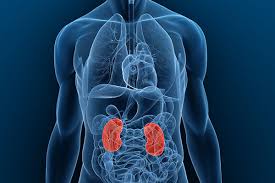

Chronic Kidney Disease Task Force studies and makes recommendations on developing and implementing a cost-effective state plan for prevention, early screening, diagnosis and management of chronic kidney disease for the state’s population through national, state and local partners; and educates health care professionals on the use of clinical practice guidelines for screening, detecting, diagnosing, treating and managing chronic kidney disease, its comorbidities, and its complications.
Members:
|
|
- Call to order and member roll call. The meeting was convened by Tiffany N. Jones-Smith. A quorum was present.
- Consideration of draft meeting minutes: March 27, 2025; June 27, 2025; September 11, 2025. The minutes were approved as drafted for all three meetings.
- No Cost Action Plan Discussion – Advancing Early Detection and Prevention; Importance of action
In Summary
- Emphasis on moving from recommendations to practical, no-cost action steps.
- Focus on early CKD identification in Medicaid and Medicare populations, leveraging existing low-cost screening tools (UACR, EGFR).
- Noted inconsistency in access to screenings across Texas due to location, health plan, and provider practices.
- Discussion on partnering with CMS and state-level organizations to promote standardized CKD screening guidelines.
- Suggestions to send recommendation letters to Texas-based societies (e.g., diabetes, hypertension, pediatric, and family medicine groups) promoting annual CKD screening.
- Proposed leveraging educational outreach, partnering with specialty organizations, and disseminating patient education materials.
- Identified opportunities to collaborate with the U.S. Preventive Services Task Force to advocate for CKD screening in national guidelines; consideration for compiling evidence and submitting white papers.
- Recognized the need to approach local initiatives (Medicaid/CHIP) before broader federal actions.
- Discussed forming subcommittee projects on provider education, patient education, and evidence compilation.
- Encouraged collaboration with other states and local organizations to amplify impact.
Member discussion
This plan has been talked about several times. The discussion is now on how to move forward picking the low hanging fruit (ensuring action). The recommendations that have been made will be implemented through an action plan.
We can have a large impact with very little cost trough kidney disease early identification through screening, risk management and treatment. People who are poor are the most at risk for kidney related disease. Low cost kidney disease screening is available and yet there are many who never get screened. We must have alignment, working in collaboration with CMS. The action plan must align with CMS. CMS has such a large reach and is in a good position to help with impact.
We do not have to start nationally, but can reach out to organizations and medical societies involved in kidney care or have them focus on screening. This could be a simple letter.
We should look at an effort to engage family members once a person has been diagnosed.
We could get specialists to present at Medicaid quarterly meeting.
We should work US preventive service taskforce. Kidney disease is not screened for asymptomatic adults. We should at least be screening high risk individuals. The task force says that kidney disease screening is inconclusive and is not recommended. Home page | United States Preventive Services Taskforce. Kidney Screening is now being investigated by the Tasl Force making this a good time to engage with them.
We have to have evidence based information to make recommendati9ons. Our letter can say that based on the evidence this is what should happen getting the evidence compiled. We do not mandate.
This could be addressed through one of our subcommittees, we can also reach out to other states as well.
Are there other Texas government agencies we could send the letter to as well. We could investigate other entities that would support our effort.
We also talked about standardizing reporting. Presently there is a lack of standard protocol. We could develop a letter for this also, though this is a complex issue because it goes into clinical care. We must have buy-in from all providers and getting too prescriptive could be a problem.
We have been doing patient education as low hanging fruit. This helps patients know what they need to know.
Can we provide educational materials to providers through fliers
The patient education subcommittee would be happy to address a flier.
Students are often looking for volunteer work. We could engage with medical students to promote community awareness. Partnering with medical schools is an underutilized resource. They are a motivated a free resource.
We must be focused internally first and then we can go into these areas as a task force.
We have to look at timeframes to ensure these efforts are manageable.
- Reminder to members to review and sign Statement by Members Document (Nondisclosure agreement, Conflict of Interest Statement)
Members were reminded of the need to submit the above-mentioned documents. This is required by the by-laws.
- Committee Groups Assignment (Share committee expectations, chairs and group assignments) A survey had been sent out, and members were assigned to subcommittees per their response to the survey and request.
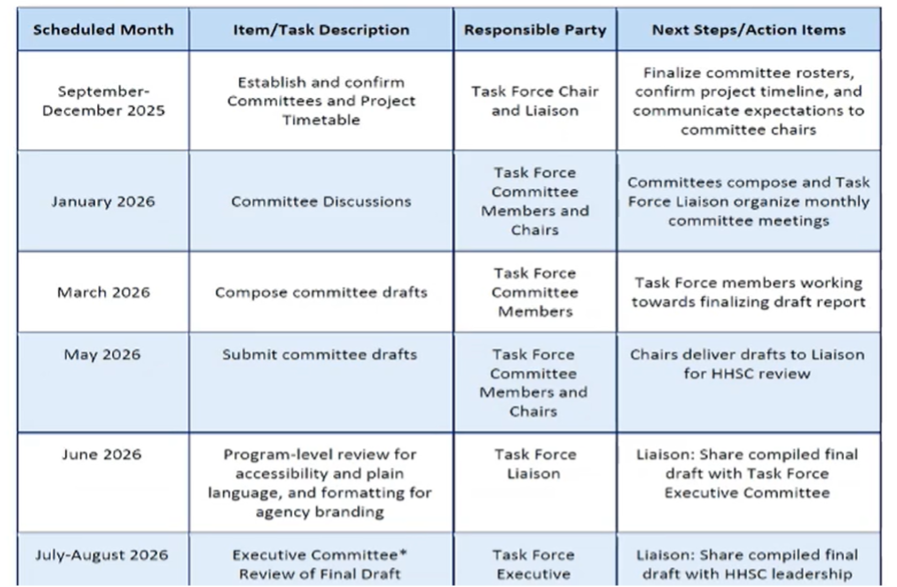
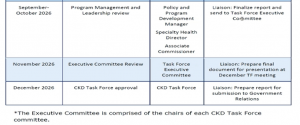
- Review CKDTF Report Review Schedule. (2026 Biennial Report Composition and Review Procedure; Committee Group Meeting Times.
Timeline for the biannual report was outlined:
- December: Confirm committees and establish schedule
- March 2026: Committees begin report drafts; next task force meeting scheduled for March 20th
- May-June 2026: Committee drafts reviewed by HHSC and executive committee
- Sept-Nov 2026: Final reviews and preparation
- December 2026: Report submission and approval
Subcommittees will meet once every 2.5 months.
- Proposed next meeting date and discuss future meeting dates.
All the future meetings will be on a Friday, per the request of the majority of the members.
- March 20, 2026 (extended time meeting)
- June 26, 2026
- September 18, 2026
- December 4, 2026
- Public comment. No public comment was offered.
- Review of items for future meeting. (March 20th)
New guidelines from international association. KDIGO – KIDNEY DISEASE | IMPROVING GLOBAL OUTCOMES
Access to care discussion (should be reported on at every meeting).
Proposed standing agenda items: access to care updates, statewide initiatives, research breakthroughs, and patient or organization testimonials (especially in honor of World Kidney Day in March).
Medicaid CHIP update
- Adjourn. There being non further business, the meeting was adjourned.
***
The information contained in this publication is the property of Texas Insight and is considered confidential and may contain proprietary information. It is meant solely for the intended recipient. Access to this published information by anyone else is unauthorized unless Texas Insight grants permission. If you are not the intended recipient, any disclosure, copying, distribution or any action taken or omitted in reliance on this is prohibited. The views expressed in this publication are, unless otherwise stated, those of the author and not those of Texas Insight or its management.